
Our first IBM TechXchange experience

When we landed in Atlanta for our very first IBM TechXchange, we knew it was going to be big, but still we underestimated how big it was going to be. Besides the 20,000 steps every day, we were surrounded by thousands of attendees, we were presented over 1,000 sessions, labs, and certifications to earn.
We’re Niki Heyligen and Dries De Jonghe, integration consultants at Integration Designers in Belgium. Day to day, we're helping clients with their integration challenges using IBM technology. In this blog we want to share how we experienced our very first IBM TechXchange.
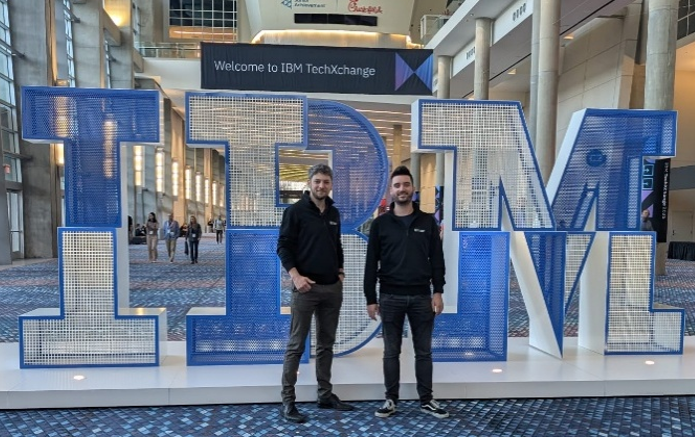
As a business partner, Integration Designers expects us to do more than just being present in the keynote sessions. We went to Atlanta to meet the experts, challenge their ideas, get hands-on experience on the latest tech evolutions, and meet like-minded engineers to share experiences.
Meeting the experts
Maybe the most valuable moments at the conference were the “Meet the Expert” sessions, where the product leaders and IBM Champions were available at tech desk stands. These were the perfect opportunities to ask direct questions about their products and discuss real customer use cases where we wanted feedback on our approach.
A glance at a few insightful conversations we had:
- Jiri De Jagere (Product Manager iPaaS & AI Strategy): Provided us with more detailed information on IBM Integration and IBM Intelligence Hub.
- Matt Roberts (CTO & Distinguished Engineer IBM Integration and Messaging): Discussed positioning MQ vs Confluent in enterprise architectures.
- Dave Pemberton (Product Manager of IWHI): Discussed the added value of Flow Pilot compared to custom skills, and the upcoming challenges for future engineers.
- Gregory Hanson (IBM Champion): Gave his perspective on how IBM MQ and Kafka best work together as they each have unique capabilities designed for specific use-cases.
- Jennifer Reif: Shared her insights on how to switch from traditional programming skills learning to an “AI first” learning mindset.
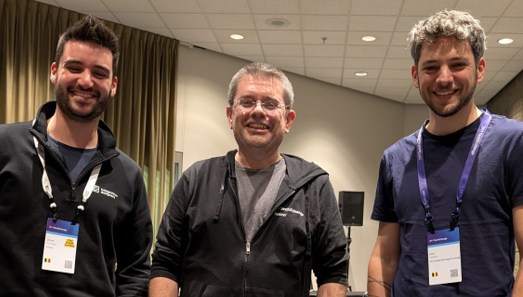
These are just a few highlights from many face-to-face talks we’ve had with many more IBM experts and Champions. Listing them all would be a blog on its own. Perhaps our most meaningful connection was with Ben Thompson, Chief Architect of App Connect Enterprise (ACE), a technology we both know well and work with regularly. We even took a picture with him!
The general line: AI orchestration and governance
If there was one main theme echoing through the keynotes, labs, and break-out rooms in Atlanta, it was this: the focus has clearly shifted from simply creating AI agents to the phase where AI agents need to be governed.
Currently enterprises are hitting a wall as numbers provided by IBM state that 95% of all AI pilots stall before reaching production. And at the same time, organizations are planning a huge scale-up in AI investments driving the average of 15 agents per enterprise to a mind-blowing 150,000 agents by 2028.
With these numbers in mind, simply giving an AI model access to tools or spinning up an ad-hoc AI assistant is no longer enough. The real upcoming challenge is giving agents the proper context while maintaining the governance required to ensure secure operation within enterprise boundaries.
The headliners: Agents, context, and orchestration
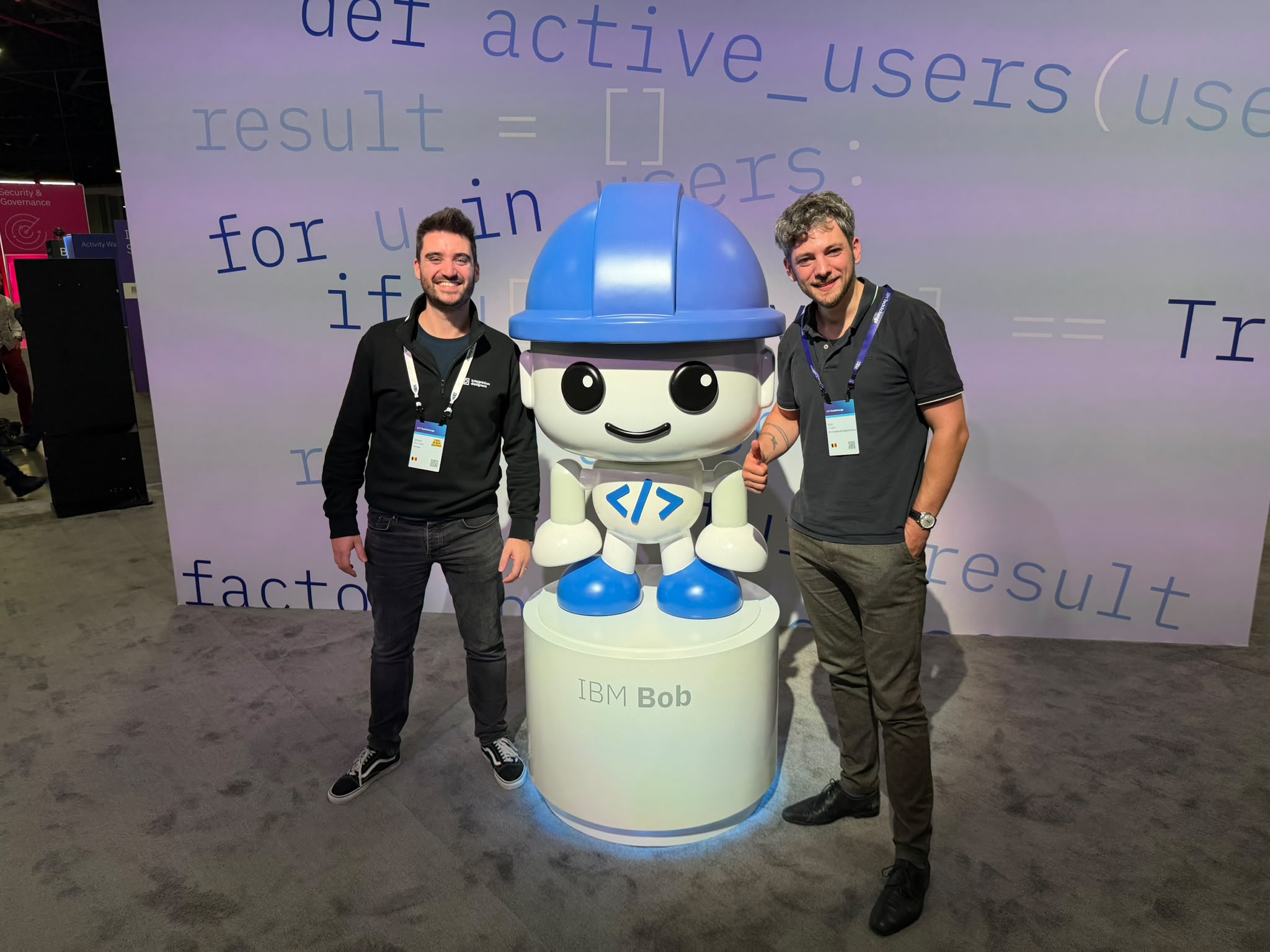
IBM Bob was the most central topic throughout the entire TechXchange. Many of the sessions, demos, and labs were linked to Bob showcasing how easy it is to build integrations and agents with Bob. During the General session, Neel Sundaresan introduced the latest features of Bob and together with Arvid Ottenberg he gave a live demo on how this all works. Important new features are:
- Bob Desktop: Enabling non-developers by providing a user interface not focusing on actual code.
- Bob Bazaar: A marketplace to browse MCP tools and skills to enhance your experience.
- Bobalytics: Keep track of how Bob is used in your enterprise and the impact on your token usages.
- Bob DevSecOps: Add security to your AI integration by including vulnerability management, compliance, and governance across the software development lifecycle.
- Bob Premium packages: Specialized domain modes like Bob for Java, Bob for I, and Bob for Z.
A second demo showcased how Bob can be a partner for not only software developers but also for completely different roles like business analysts. If anyone still doubts, IBM Bob is there to improve both the quality and the speed of your work. We are already certified as Bob V2 developers.
IBM Intelligence Hub was one of the new products announced at TechXchange Atlanta. This is designed to become a critical component between an enterprise's existing complex infrastructure and the newly created agents. Its main purpose is to make existing enterprise capabilities such as applications, APIs, messages, events, … discoverable, understandable, and reusable. Most enterprises have already invested heavily in their infrastructure and software. The Intelligence Hub prevents the need to start from scratch by bringing all these capabilities into an agentic environment. This agentic environment contains the five core pillars for an effective AI integration:
- Capabilities (MCP tools)
- Methods (Expert skills/playbooks)
- Asset inventory
- Dependency tracking
- Policy governance

One should look at Intelligence Hub as the middleware layer between AI coding assistants (like Bob.Copilot) and product-specific flow pilots. It will use the Asset Explorer to understand the enterprise context and dynamically provide the best suited skills and tools needed to solve the described problem. Intelligence Hub works perfectly together with tools like Bob, enabling developers to easily discover existing capabilities matching their requirements.
Scaling up also means managing the risks. Watsonx Orchestrate functions as the central control plane. It doesn’t just provide insights into performance and cost, but also capabilities like Agent Identity, real-time control, and keeping the human in the loop for high-impact actions. DataPower Interact Gateway provides the enforcement layer for this governance. It governs how agents and AI assistants access enterprise capabilities, applying policies at the point of interaction and helping ensure those connections are secure, controlled, and auditable. Together with Intelligence Hub and watsonx Orchestrate, it helps bring governance from discovery and oversight into the actual flow of agent activity.
As we expect the number of agents to grow rapidly, the challenge for the coming years won’t be the development of new agents, but the governance of all these agents. In a session, Matt Roberts showed how assets from IBM App Connect Enterprise can be exposed as MCP tools for AI assistants and agents to use. It was a great example of how existing integration capabilities can be made available in an agentic environment, rather than having to rebuild them from scratch.
The challenge is and has always been context
An architecture announced at TechXchange, but which seemed to get slightly less attention, is StreamHouse. As integration consultants we found it very interesting, but it seemed to be less present during the event (this could just be us).
One big misconception is that agents need access to all the data available in the enterprise. Instead, they need a well-defined subset of data they know to be true now, also known as a Bounded Context consisting of state (what is true now) and change (receiving updates at the moment they happen).
When we look at traditional integration patterns like API polling, we see two major disadvantages:
- The data is available only when the agent polls. But the agent will also call for updates, even when there are no updates. This results in needless status update requests.
- The data traffic increases with each new agent, directly resulting in more needless poll requests.
An agent’s biggest enemy is slow and outdated data (stale data). The moment the human factor is no longer slowing down the process, the data architecture becomes the primary bottleneck. Outdated data leads to confused agents, causing errors that ultimately force human interventions.
Meet data where it lives with StreamHouse
To solve this, StreamHouse continuously captures, transforms, and governs data streams. Instead of centralizing everything or moving massive data loads, it is built on the principle of “meet data where it lives” using open standards like Kafka, Kafka Connect, Flink, Schema Registry, and Iceberg within the Confluent ecosystem.
Typically, StreamHouse is more than just data streams. It works together with traditional lakehouses. The lakehouse provides the necessary historical depth and long-term context, while StreamHouse provides instant and real-time streams for operational decisions.
Personal observation: the position of Confluent
Another interesting observation was the presence and positioning of Confluent. Since the acquisition earlier this year, we expected Confluent to be more deeply integrated with the IBM ecosystem by now.
Confluent was certainly very present with multiple Tech Desk sessions, a general session on StreamHouse, and numerous use-case presentations. However, we did have the feeling of a bit of a “Confluent vs. the world” dynamic. Many Confluent experts still positioned their platform as the main solution capable of solving nearly every data challenge, whereas IBM Champions and product owners positioned it as a powerful tool for specific use cases, best combined with other integration products to form a complete, well-balanced platform.
From an integration consultant perspective, this confirms our belief that it is not an “either/or” question. Apache Kafka/Confluent and IBM MQ serve fundamentally different primary use cases.
IBM Champion Gregory Hanson delivered a brilliant session about “IBM MQ and Kafka: the best of both, and better together!”. Using Pokémon kisses to visually showcase the differences between the two eventing paradigms was easily one of the most creative presentations to tell the story.

Outside the TechXchange
Attending TechXchange wasn't strictly about Bob, code, architectures, and keynote sessions. We also got some time to experience Atlanta itself. And if there is one word to summarize the city, it’s huge. From the size of the avenues to the massive portions at restaurants, everything in Atlanta feels to be two times the European size.
Food, however, was a challenge. It is very different from what we are used to in Belgium, where everything seems to taste less sugared.
One of the coolest non-conference highlights (and this will sound strange for many people) was getting to ride in a Waymo, the driverless taxis. Sitting in a car driving from downtown to the suburbs and back through traffic while being addressed in our native language was a special experience.
IBM also provided entertainment after the sessions with a Night Block Party for Champions and partners on Monday evening, and on Wednesday we were invited for an evening at the Georgia Aquarium and World of Coca-Cola. What a nice way to network with drinks and food and at the same time explore the main tourist attractions of Atlanta. Great experience!
Conclusion
Looking back at our very first IBM TechXchange, the trip to Atlanta was worth every single step of the daily 20,000 steps.
We didn’t just come back with fresh certificates; we came back with a lot of new information to share with our colleagues and clients. Some key takeaways:
- Governance is the real AI challenge: Control planes like watsonx Orchestrate and IBM Intelligence Hub will become vital.
- StreamHouse patterns: These will help us adapt data architectures to match AI latency requirements.
We are ready to take these insights, share them with our colleagues and clients, and build future-proof, AI-driven integrations.
